Small Towns of Queensland

Wednesday, August 11, 2010 by Sarah
Queensland north of Bundaberg seems a lot like the American mid-West – filled with small towns, all built on a grid system, populated with squat purpose-built buildings. It feels like you've been transported back in time to the mid-1950s.

This is definitely the working part of the state. As we learned in Bundaberg, the dominant industry is sugar cane, and we drove past more fields of sugar cane all the way up the coast. Sugar cane trains regularly sped by along the railroads, as it's currently crop harvesting time over here. A visit to the Sugar Industry Museum (no really, it was fascinating) taught us that Australia is the second biggest global exporter of sugar, second only to Brazil. Although mechanisation has gone some way to modernise the industry, it still seems pretty traditional – much like the towns the workers live and drink (Bundy) in.

After a while, all these towns started to merge together a bit, but here are a few of our highlights:

Gympie (seriously) is a former gold-rush town, which reached its peak in the mid-19th century as the first gold mining town in Queensland. Today it is home to such gems as the 'Hair Force One' hairdressers and 'A Man's Toybox' – which is a tractor store, before anyone gets any other ideas.

Maryborough was actually the hometown of PL Travers, who wrote Mary Poppins. This appears to be its sole note-worthy feature; aside from this, it's just another quaint market town.

Rockhampton, or 'Rockie' as it's affectionately known to locals, prides itself on being the Beef Capital of Australia. There are apparently, some 2M cows within 250km of the town, and to celebrate this fact, the powers that be have commissioned...wait for it....6 life-size plastic cows around the town's main streets. It didn't exactly match up to Bath's pigs back in the UK, but we did amuse ourselves for some, oh, 10 minutes trying to find them all.

We learned that boozy Mackay is considering closing its main street of a weeknight in order to dissuade drunken teens from hanging around and making a nuisance of themselves. Considering how little there is to do there, it's hardly surprising that they are turning to alcohol – we were just amazed it wasn't anything stronger. It does have a nice beach though.

Bowen amused us with its 'Bowenwood' sign up on the hill as you drive into the town. Someone on the council clearly has a sense of humour.

Townsville. What is the point of Townsville? Seriously? Allegedly the 'second biggest town in northern Queensland,' we struggled to find its centre. Were it not for the free internet in the library we would've struggled to fill half an hour. But perhaps I'm just being unkind, and there's a thriving....something....going on there somewhere that we just missed.

Much more to my liking was Innisfail, a town from the 1920s. When most of the (timber) buildings were destroyed in a cyclone in 1918, the people decided to rebuild in stone, in keeping with the fashion of the day. As a result, the whole place is constructed in an art deco style – lots of rounded edges, portholes and sunbeams. In order to keep things consistent, all new buildings have to be designed in the same way, and so the effect is like being on a film set. James was less than impressed and stayed in the car, but I insisted on doing the walking tour of the main street, to fully appreciate the place.

Much more exciting than most of the towns (Innisfail excepted) were the giant objects which Australia has erected as random 'tourist attractions' in this part of the world. We first read about them in Bill Bryson's 'Down Under' and had I not now seen a few with my own eyes, I wouldn't have believed they existed. The giant objects tend to be something which locals believe sums up the character of their village or town. So far we've seen a giant mango and a wellington boot, to commemorate 'the wettest town in Queensland.' Tully received some 7.9m of rain in 1950, thus beating out Innisfail and Babington to the title. The giant boot is exactly 7.9m tall, and you can climb an internal spiral staircase to reach the top and get great views....of the sugar cane factory opposite. Apparently there is a giant lobster and also a giant koala somewhere around here too. I live in hope of seeing them before we leave.

Cruising the Whitsundays

Tuesday, August 10, 2010 by Sarah
We were lucky enough to spend two incredible days sailing around the Whitsunday Islands in a racing yacht called the Iceberg. For the sailing enthusiasts amongst you (Tom) it was a 52 foot fractionally rigged sloop, originally built for the 1992 Sydney to Hobart Boat Race, which it competed in for four consecutive years. Neither of us had ever been on a proper sailing boat before and so we were pretty excited.

We were a little nervous initially as the weather was not great: overcast with a changeable wind, which made the sea pretty choppy. On the first morning we motored out through the waves with our sails down. Everyone was starting to feel a little bit seasick, and so our first lunch was a fairly quiet affair. However, the weather gods were smiling upon as, as the skies cleared up and the sun came out in the early afternoon. And so we saw the Whitsundays in their absolute best conditions – blue azure seas and clear skies during the day, starry skies at night.

The Whitsundays are made up of some 60 islands off the coast of Airlie Beach. Almost all of them are partially or completely designated as national park, and only a handful are actually open to the public at all. As a small boat (just 12 passengers on board), we had close access to some of the islands' highlights, which most bigger boats are not allowed near. The most famous of these is Whitehaven Beach, a 6km stretch of white sands and blue seas – we were the only people on the beach, with the exception of the owners of a helicopter which landed moments before us. Alright for some.

There was also time for a 'bonus beach' on our second morning. The Langford Sand Spit is a stretch of sand between Hayman and Hook Islands which only appears at low tide. This was a natural paradise, with turtles and stingray swimming in the shallows. Our trip here followed a morning of impromptu whale watching from the boat – July to October is whaling season, when pregnant humpbacks come inland to give birth. We saw about 8 or 9 whales in fairly close proximity, including one who, showing off, spent a good 10 mins with her fin in the air. It was an amazing sight.

But the absolute highlight had to be the snorkelling. We had two snorkel stops in all, both on the fringes of the Great Barrier Reef. The best of these was a stop just off Blue Pearl Beach on Whitsunday Island. The water was crystal clear and so we saw shoals and shoals of colourful fish, including yellow-tailed fusiliers, sergeant fish and parrotfish. But most impressive was the enormous Napoleon Reef Wrasse, a fish bigger than me which was happily swimming among us. It's left us feeling incredibly excited about our upcoming diving trip further north.

A few words on language

Sunday, August 8, 2010 by James
'Two countries separated by a common language' applies just as well to Antipodeans as it does to Americans. It seems they insist on abbreviating everything to the shortest, most casual form possible.

The classic examples (gleaned from years of Neighbours watching) are:

Afternoon → Arvo
Chicken → Chook

But how about...

Breakfast → Brekkie
Strawberries → Strawbs
Pedestrians → Peds
McDonalds → Maccers
Vegetarian → Vego
A Politician → A Pollie!

I'm not even sure if these can be called slang either, as they're used by absolutely everyone, regardless of how formal the occasion. Having been in Australia for the build up to the recent general election, we tuned in to watch the first of the televised debates when we were in the Blue Mountains. The leader of the opposition Tony Abbott began his opening statement, 'I want to give the Australian people a fair go.' A Fair Go!!! This is apparently his key campaign message! He then went on to use the phrase 'Fair dinkum' twice in the first five minutes before we turned the TV off.

A variation on pure abbreviation, there's also a fair amount of very literal slang in Australia. My favourite is the name they give fruit machines over here: 'Pokies.' I was buying some beer in a 'bottle-shop' and asked the shop keeper if they were screw caps or not: 'Twisties? Yeah I reckon.'

P.S. One last bit of slang worth mentioning purely for its crudity. Apologies, but - Shit-arse. As in 'Are you working this weekend?' 'Yeah... Shit-arse.'
Posted in Labels: , , | 0 Comments »

Bundy & Coke

by James
A Bogan = An Australian cross between a redneck and a chav

Bundy = Bundaberg Rum, Bogan drink of choice

Much of the north of Queensland is given over to sugar cane farming. The industry has been going strong ever since the 1770s when cane was brought over by the First Fleet. The plant was supremely suited to the rich coastal soil and sunshine of the north – Highway 1 cuts through miles and miles of sugar cane farms on the way north to Cape Tribulation.

Where there is sugar, there is rum. Having discovered the spirit during their West Indian endeavours, rum became the drink of choice for British colonialists in the 18th century. Rum was therefore very much a part of life in 'New Holland', especially for the convicts and navy types who made up most of the original settlers. Taxes from rum sales built most of Lachlan Macquarie's famous civic buildings that we saw in Sydney.

With this vibrant market in mind, in 1885 Mr Frederick W. Buss proposed to a group of local sugar millers that they club together and build a rum distillery to generate some extra cash from the otherwise wasted mollasses – a by-product of their refining. Despite burning to ground twice within the space of 50 years, the distillery was a great success and still exists on the same site, next to the Millaquin Mill on the outskirts of the town of Bundaberg.

Having heard a bit about the rum brand from our friend Kate, both Sarah and I were looking forward to visiting the distillery on our road trip up the coast.

The distillery is as straight-up and no-nonsense as the brand. No smoke & mirrors here. Rolling up the dirt track to the front gates we the raw chopped cane shunted past us in dusty cane trains. On the tour we were taken into the working distillery and saw the Olympic swimming pool-sized vats where they store molasses, their column and pot-stills, the bonded warehouse where they age their rum in giant 60,000l barrels and the small bottling line where they package their main brands.

There was also an interesting museum section which displayed historical advertising for the brand. Bundy's big breakthrough came in the mid 80s when the marketing manager introduced a new logo and label for the rum that, inexplicably, featured a polar bear. The bear has since become so iconic that no-one seems to ask why he was chosen as the front-man for an Australian rum made in sub-tropical Queensland...

Sarah and I both enjoyed tasting the finished result in the Bundy bar. We found Bundy Original to be pretty rough straight up (bloody soft Poms!), and much preferred the new Bundy 'Red' which is filtered and has some added vanilla for smoothness. We bought a couple of tinnies for the road and after a break for lunch to let the buzz die down to legal levels, we drove off into the sunset.

Noosa

Saturday, August 7, 2010 by Sarah
Like the Gold and Sunshine coasts, Noosa appears to be something of a retirement community, albeit an incredibly premium one. If the Sunshine Coast is like Florida, then Noosa would be the Florida Keys. It also appears to be a popular holiday destination, judging by the numbers of people we saw enjoying week-long breaks. Filled with gourmet restaurants and boutique clothing stores, we could definitely understand why.

We only had time for an overnight stop before it was time to head on up the coast, but we made the most of it by booking in for another surf lesson. On recommendation, we'd booked with Merrick's Surf School – Merrick being an ex-Aussie champion surfer, who now runs a surf school from the back of a van in a car park. We were a little concerned, especially with 5 of us in the class, and a slightly delayed start, that our second lesson wouldn't match up to the first. However, there was no need to fear – if anything, this lesson was even better. Our instructor was a laid-back surfer dude from Newquay called Tim, and although we were given a little bit more free reign to catch our own waves, he gave us great feedback about how to improve after each ride.

I also discovered my surfing skills weren't in fact a fluke, but that I am actually a fairly competent novice surfer. As well as standing up to catch a few waves, I even managed a pretty impressive-looking 'backside run along a long right-hander' (or so I'm told), which prompted compliments not only from a couple of silver-haired female boogie boarders, but also from James, who I think was a little bit jealous. A surfing holiday could definitely be on the cards in the near future.......

Gold Coast, Sunshine Coast.....

Friday, August 6, 2010 by James
The Gold Coast is the name of the stretch of coastline beginning at Coolangatta, running up to Surfer's Paradise. Past Brisbane it morphs into The Sunshine Coast, which ends around Noosa before becoming the Fraser Coast (around Fraser Island) then The Capricorn Coast (around the Tropic of Capricorn). I thought these were all just nicknames, not real places with street signs and logos and everything. 'Welcome to Surfer's Paradise - a part of The Gold Coast'.

Regardless of which part of the Queensland coast you are officially on, the coastline itself is stunning. After leaving Tweed Heads we drove north from Coolangatta as close to The Gold Coast as we could, 50km of endless sunny beaches, increasingly expensive beachfront properties and world class waves. Unsurpringly, we heard that this is Kelly Slater's favourite patch of sea.

Surfer's Paradise (named by a clever hotelier who lobbied to for a name change from the less marketable 'Elston' in the 1930s) was a strange place. We've heard it compared to Miami, but in my opinion this does great disservice to my friend Shan's hometown. Surfer's has none of Miami's slick and sexy glamour - it felt more like a town on the Costa del Sol. Aside from its near perfect beach and abundance of strip clubs, we found no reason to be there. We stopped in for a coffee and some internet time in Maccers (McDonalds – the only place in Oz with free Wifi and cheap coffee), just in time to see a junkie evicted from one of the booths by the police.

From Surfer's we headed inland and skirted around Brisbane to Mooloolaba and the start of the The Sunshine Coast. Everything changed. The coast was just as incredible, but suddenly the comparisons to Florida made sense. Palm trees, strip malls and 2 lane highways everywhere, drive-through McDonalds and the average age jumped to around 65. East Coast Americans retire to Florida, East Coast Aussies to The Sunshine Coast.

I hoped Noosa would be nicer...

The Griffiths Family, Down Under

Thursday, August 5, 2010 by James
In the 70s my grandpa's brother Jack Griffiths emigrated from Wales to Australia with his wife Enid and their kids Pam and Lynn. The family flourished, and there are now two more generations living in the area of Tweed Heads.

(They weren't the only Griffithses to move down under. Over the last couple of weeks I've been shocked by the number of Griffiths Streets, shops and even islands dotted around!)

Tweed Heads is all of 40 minutes drive from Byron Bay, so our first morning in the surfer town I rang Aunt Enid out of the blue and at very short notice we arranged that Sarah and I would pop around to say hello the following day.

We spent the intervening night testing the limits of our campervan by sleeping in a motorway lay-by – a trick not to be repeated – so were most receptive to the spoiling we received at Aunt Enid's the next day. Despite having celebrated her 90th birthday earlier this year (by travelling 200km into the outback in a campervan), she had clearly been slaving away in the kitchen all morning. Soon after we arrived we were having high tea complete with chocolate cake, Victoria sponge, an apple tart and last but definitely not least...Welsh cakes!

Everyone was there to meet us. Pam, Lynn, Pam's daughter Elizabeth, her husband Mike and their baby boy Charlie. Lynn regaled us with stories of going to Sully Primary School with my mum as we sat out on the balcony and watched trawlers and dolphins in the river below.

After tea we took a drive into town to see the state border and what was one of Uncle Jack's favourite walks. Half of the town is in New South Wales – the part called Tweed Heads – and the other half is in Queensland – Coolangatta. We parked up next to the border and walked around the 'head' itself, criss-crossing between states. Below us crowds of bobbing surfers in the bay, and in the distance to the north the high-rises of Surfer's Paradise floated like a mirage.

Not having really understood the scale of Australia, we were planning on driving on from Tweed Heads to Noosa that evening. On sharing our plan we were met with sceptical looks, and it was explained to us that Noosa is a good five hour drive away. With very little persuasion, we agreed to stay the night at Mike and Elizabeth's house and tackle the drive in the morning. We had a wonderful evening being entertained by Mike, Elizabeth and Charlie. We traded travelling stories with Mike and Liz and they told us all about their time in the UK, and Charlie presented us with various of his favourite toys and also showed us his brand new racing car bed. Pam then brought by a 'back up' casserole she had prepared and we went to bed in a luxurious double bed in the guestroom glowing with the warmth of their hospitality (and wine).

Thanks again guys for having us!

Surf's up!

Wednesday, August 4, 2010 by James
Byron Bay was the southern-most point of our 2 1/2 week Aussie Road Trip. Over the next couple of weeks we plan on driving north all the way to the end of the road at Cape Tribulation, stopping in on some far flung family in Tweed Heads, the Whitsundays for some sailing, and Port Douglas for a day's diving on the Great Barrier Reef. Lots to do, and lots of ground to cover!

We rolled into Byron just after sunset, the remains of the day a deep orange scar over the dark waters of the bay. We were staying at a campsite just out of town, and used our little gas stoves for the first time to cook spaghetti bolognese by torchlight. This proved tricky - we made a note to do our cooking before sundown in the future – but we managed. It must have smelled good at least, as we managed to attract a curious possom out from the undergrowth. He darted out from under our car as I was serving up, then darted back when I shone the torch on him, to Sarah's relief.

Not having been able to properly see the town the previous night, the next morning I was a little trepidacious as we drove back into the center. Having heard so much about Byron Bay as a surfing mecca, I expected it to be a little over-exposed, potentially filled with cheesy surf-themed bars and gap year kids getting smashed - like Newquay but with sun.

I was pleasantly surprised. Bryon is a small town, really only a few blocks of low rise buildings occupied by a mix of surf shops, coffee bars and restaurants. Not much to look at, but the whole place was wonderfully laid back. Lots of locals were happily ambling up and down the streets towards breakfasts and morning cappuccinos. It reminded me a lot of Hossegor in the South of France – another relaxed surfing town.

Of course, we weren't there to hang out and drink coffee all day (although we did actually spend a good part of our time there doing just that) – we were there to surf!

The next morning saw us wet-suited and wading into the cool waves of Byron's Main Beach. Jeff our instructor (a 40-something professional surfer dude who was the spitting image of Steve Tyler - Aerosmith's lead singer and Liv Tyler's dad) assured us that conditions were pretty much perfect – 1 to 1.5 metre high waves held up by a light offshore breeze, combined with a virtually empty beach and not a cloud in the sky. Perfect for Sarah's first surfing experience, and for me to demonstrate my remarkable ability to swallow large amounts of sea-water.

She was an absolute natural. Within 20 minutes Sarah was paddling, standing-up and cruising into the beach with a big grin on her face. Despite having several surfing holidays under my belt, I was less successful. It was a question of timing. I alternated between catching big waves late or small waves early – the former threw me off the front of my board and rolled me along the sea-bed, the latter required a hefty amount of paddling for not a lot of riding. After half an hour I was completely knackered and so decided to spend the rest of the lesson sitting on my board out beyond the breakers catching rays rather than waves.

I love koalas and koalas love me

Monday, August 2, 2010 by Sarah
Lone Pine Koala Sanctuary is about 11km south of Brisbane, so was our first stop in our Spaceship campervan. Home for the next two weeks, the van boasts a fridge, DVD player and even an iPod dock. It's pretty compact, but seems to be a popular way to get around, judging by the number of vans we've seen on the road in recent weeks.

Anyway, back to the Sanctuary. Lone Pine, the world's first and largest koala park, was opened in 1927 with just 2 koalas. It now has some 130, ranging from newborns to the old grannies – koalas generally live until they're 11 but some here were up to 15 or 16. The oldest koala (according to the Guinness Book of Records) is from here and lived to the ripe old age of 23. She was called Sarah.


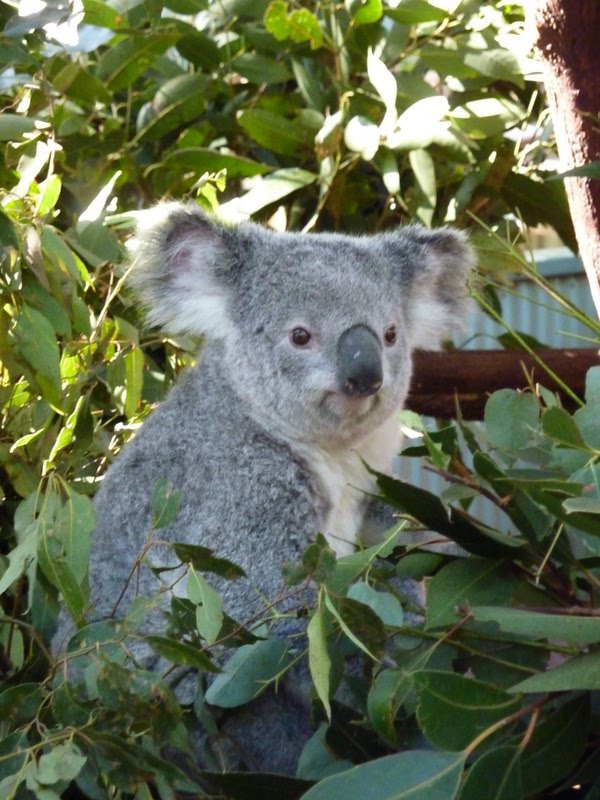
I was totally besotted with koalas – they were so cute and cuddly, exactly like real-life teddy bears. As a result, I insisted that we stop and stare at each and every enclosure, numbering about 12 in all. Some of the koalas were active, munching on eucalyptus leaves or climbing around, but the majority were asleep – like the bamboo-eating pandas we saw in Chengdu, a diet of glorified lettuce leaves gives the koala very little energy, which results in a lot of sitting and staring. This is why diets are bad for you.

I was so excited that James paid for me to cuddle a koala – a little boy called Wiley, about 2 years of age. He definitely cuddled me back, and though he was a little smelly, he was very cute indeed. My maternal instincts seemed to have been transferred to the koalas for the morning, as I wandered around goggly-eyed and grinning like an idiot.

Whilst koalas are the park's raison d'etre, it is also home to many other animals, including platypus, dingos, wombats and a wide variety of birds. We went to the snake house, filled with poisonous snakes which I couldn't even bring myself to look at, so deep-seated is my snake phobia. But then, considering we're in the country that's home to the 10 most venomous snake species on earth, I think most reasonable people would be fairly terrified too.


The park's other specialty appeared to be kangaroos, and we spent a lot of time in the kangaroo enclosure. A well as the kangaroos and wallabies, this park was also filled with a whole host of humans, who had bought roo feed and were intent on hand-feeding the marsupials, whether they liked it or not. In some cases, one rather bored-looking animal was surrounded by 3 or 4 humans, cupped hands outstretched, their relatives ready with the camera to take the perfect shot. The animals were incredibly tame, and I'm sure the majority were happy to be fed, although a couple hopped off to escape the pestering. It was amazing to see the famous hop in action. I followed a roo around with my camera, taking a few steps towards it at a time, in order to 'encourage' it to hop away. I did catch myself wondering actually whether this b ordered on animal cruelty, but I got a pretty good video out of it.

24 hours in Brisbane

Sunday, August 1, 2010 by Sarah
Brisbane is affectionately known as Brisvegas or Brisneyland by disparaging Melbourners and Sydneysiders, so our expectations were low on arrival. In fact we found it thoroughly delightful, albeit on a smaller scale than its southern cousins – we managed to see all of the major sights within a 24 hour period.
We arrived to find the city bathed in sunshine, and it was a relief, for me at least, to be back in shorts and T-shirts, after nearly three weeks of colder weather. We thought we were doing well to be out and about by 9.30, only to find once again the city centre was packed with families having breakfast and lots of people participating in another 'festival of running' – the marathon was already 3 hours through, and the 10k was about to kick off. Australians are most definitely early risers!

We spent most of the day doing a walking tour of the centre. Brisbane is full of familiar-looking Victorian buildings, as in Melbourne and Sydney, but here most of them have been refurbed for more modern pursuits – the grandest of the buildings, the former Treasury, is ironically now the city's premier casino, and the old Land Administration Building has been transformed into the finest hotel in the area.

Brisbane also has its fair share of art galleries and museums, mostly grouped along the Southbank (sound familiar?) If Melbourne's Southbank is how London would like to be, Brisbane's is how Melbourne would like to be. Along with the cultural pursuits there are a host of nice restaurants, an urban beach and a beautiful flower arbor. But the highlight here was the Whale Walk, a connecting covered walkway between some of the museums, which featured giant whales suspended from the ceiling, and piped whale calls reverberating around the space. I guess you had to be there, but James and I had a lot of fun practising our whale calls (his is better than mine). We also really liked the QUT (Queensland University of Technology) Gallery, which was small but perfectly formed, boasting a display on the Japanese influence on western art.

Wanting to escape the biggest backpacker hostel ever (60+ rooms) we decided to go to the cinema to see Inception. I am sure most of you have seen it by now – we both really enjoyed it, even if it was a little bit too clever for its own good. However, I was properly freaked out on the walk back, convinced there was a couple following us all the way (a good half hour walk through deserted suburban streets with no street lights). Turns out they were staying at the same hostel as we were......or were they?!