Showing posts with label malaysia. Show all posts

Hanging with the Headhunters

Saturday, July 3, 2010 by James
On the way back from Niah Caves, we stopped to visit an Iban longhouse. The Iban are the largest of the native tribes of Malaysian Borneo, and longhouses are their traditional dwellings. As the name suggests, longhouses are big long houses within which all members of an individual tribe can live together. They come in all shapes and sizes - some more traditional and wooden, others new and made of brick and concrete; some with satellite dishes and new cars parked out front, others built by poorer tribes from a patchwork of rusted corrugated steel and salvaged wood.

We entered the longhouse from one end into a large corridor that stretched the entire length of the longhouse. This was the main shared space of the longhouse, the centre of communal life for the tribe. The corridor was about 5 metres wide and 200m long, with a floor of polished timber. All the way down the left hand side were the front doors to the apartments of individual families – about 80 in total. The beauty of a longhouse is that as the tribe grows and more families join the tribe they simply build more apartments on to the end of the house.

As walked down the corridor a couple of small children peered around one of the doorways, giggling with amazement at the foreigners and shoving their terrified younger sibling out in front of us, who shot back inside like a startled cat. We snuck a look in the open door after him and caught a glimpse of large sofas, rugs and a widescreen TV. A comfy modern home.

On the right hand side of the communal space, doors open out at regular intervals onto an exposed wooden balcony, where rice and wood and washed clothes are dried and feats are held during important festivals (including the annual harvest festival). Sitting on the floor in the breeze of these doorways were many groups of older tribespeople, whiling away the day with gossip.

Halfway down the longhouse is the chief's apartment, outside of which, hanging from the ceiling in the centre of the corridor is a collection of wicker and rope netting. As we got closer, we saw the skulls hanging within. These were the skulls of the tribe's defeated enemies – the Iban used to be head-hunters. Inquiring of a group of old men and women quietly chatting near the skulls, our guide told us that they belonged to fellow Iban from a rival tribe that they fought long-ago.

Talking further with the tribespeople in Malay our guide told us that they were quiet today because they were all tired from staying up late to watch the football, and most of the younger men weren't even awake yet, having drunk a little too much rice-wine with the game. Once they ascertained that we were from England, one of the men slapped his hand to his head and said, 'England? Wayne Rooney! England he play badly! No good! Play better Man United!'

To the Batcave!

by James
From Brunei we took a short 6 hour bus ride back into Malaysian Borneo, crossing the border at Kuala Belait. I then spent 16 hours holed up in a hostel in Miri with the tail-end of a bout of food-poisoning, willing myself well in time for a tour to the Niah Caves that we had booked for the following morning. Sarah tells me she spent a lovely afternoon exploring the 'sights' (browsing the shops and getting a pedicure).

Aside from a mild fever virtually indistinguishable from my base-level of tropical sweatiness, the next morning I was good to go and we set off with our guide Ken west on the coastal road to the limestone cliffs of Niah.

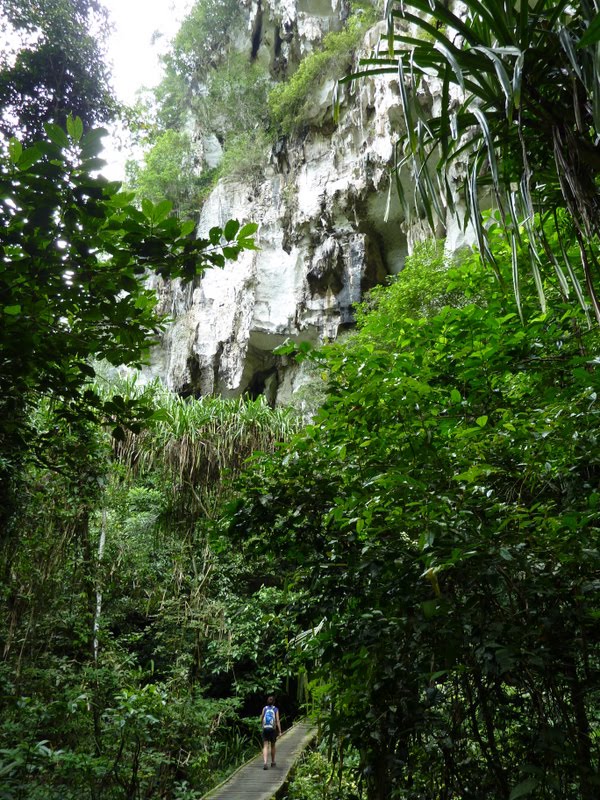
The Niah Caves are the result of similar limestone rock formations to those we saw in Halong Bay in Vietnam – they're enormous humps of rock, big sore thumbs in an otherwise flat jungle landscape. In Halong Bay water still laps the base of these rocks, in Niah the sea has rolled back several miles leaving jungle and more palm oil plantations between the beach and the caves.

Niah and its big brother Mulu (another set of caves in Sarawak) housed some of the oldest recorded human settlements in the region. Inside the mouth of the Great Cave at Niah, 'modern' human skulls have been found in a highly organised burial ground that dates back 40,000 years – the oldest in the whole of S.E.Asia – as well as a series of very faded cave paintings of boats and monsters dated at 20,000 years old.

We strolled the 4km from the camp to the caves, protected from the rainforest by a raised wooden walkway, before climbing the wooden staircase up the face of the limestone cliff to the enormous cave entrance. Once inside the mouth of the Great Cave, sunlight quickly became a distant memory and our torch did little to penetrate the heavy darkness around us. Following our guide's heels, we felt our way over damp wooden walkways deeper into the cave system. Only the clicks and screeches of bats and the echoes of dripping water gave us an idea of the scale of the space, until we rounded a corner and saw light lancing down from holes in the cave roof 50 metres above us.

Tourism in the Niah caves exists side by side with two older industries – guano (bat shit) farming and birds' nest collecting. Nitrate-rich guano from the 2-3 million bats living in the caves is shovelled up daily by groups of locals living in camps within the caves and sold as an expensive natural fertiliser. The ammonial stench hit us like waves in the more popular bat-caves. I've no idea how the farmers live with it day-in day-out.

Bird's nest collecting is a less disgusting but much higher-risk profession. Collectors ascend 100 foot high bamboo poles to knock down Swiftlet nests attached to the cave roof. The saliva that the birds use to construct their nests has supposed aphrodesiac properties that make them the most valuable ingredient in Chinese 'bird's nest soup'. It is this rich export market that causes otherwise sane locals to climb to such heights with no ropes.

Both these professions require their practioners to live in the caves in semi-permanent camps to guard their territories from interlopers. As we walked through the caves, we came across a guano farmer standing by the walkway on a rock in the milky half-light, smoking a cigarette and looking very much like an overgrown Golem – wearing only shorts and a non-functional head-lamp, he was skinny and pale with clammy-looking skin that stretched over a little pot belly. After our guide exchanged a few words with him ('Nice weather'?!?) we walked quickly on.

Welcome to the Jungle

Sunday, June 27, 2010 by James
My favourite ride at Barry Island Fun Fair has always been The Jungle Ride. You sit in a plastic boat in a couple of inches of murky water and wobble through a cardboard wilderness as a series of plastic animals take it in turn to pop out from behind trees and bushes. It's awesome.

Travelling up the Kinabatangan River in Borneo is kind of like The Jungle Ride. The water is just as murky but the boat is a little faster, the wilderness a little wilder and the animals a little furrier. Our stay on the river definitely ranks up there as one of my highlights of our trip thus far.

From base camp near Sepilok, we drove for a couple of hours over gravel roads to a small village on a river where we loaded our packs and supplies onto speed-boats that took us upriver and into the wilderness. On the way up the river we spotted our first wild orangutan, sitting in between two branches of a fig tree about 15 metres up over the water. As we slowed down to stop at the bank beneath him he took a look down at us, then resumed his lunch - slowly chewing his way through branch after branch of the tree's fruit.

'The Man of the Forest' is a solitary, territorial animal, and so spends most of his life on his own. Each time we saw orangutans over the next few days, slowly moving through the trees or sitting watch over the river with their soulful dark eyes, it was hard not to feel that they might be lonely, especially in contrast to the happy, playful packs of macaques roaming the treetops.

Over the next few says we set out on a number of dawn and dusk boat rides up and down-river, one day trek into the jungle and finally one night trek. We saw the most wildlife out on the river (orangutans, long-tailed macaques, proboscis monkeys and gibbons, as well as plentiful hornbills and egrets and even one incredibly menacing estuarine crocodile) but the treks into the jungle were just as exciting.

The rainforest is unlike any other environment I've experienced. As you step out from the safety of camp you can feel some very basic survival instinct flip into high gear as your brain struggles to process the sheer density of new sights and sounds, sorting the dangerous from the mundane: screaming cicadas, whirring mosquitos, the crash of foliage as birds move ahead and all around you the shifting green shadows of lianas, leaves and ferns. Through this aggressive terrain our guide strolled barefoot, only slipping on low rubber shoes at night in deference to the fire ants.

Sarah coped with the stresses of the jungle incredibly well during our stay, especially considering she doesn't like camping, has never been hiking before, and is morbidly afraid of half the things we were actively looking for. Creeping around in the jungle during our night trek with eyes wide and shoulders tensed, her head torch was like a strobe-light as she scanned the branches above her for opportunistic pythons and spiders, but by the time we got back to camp she had the biggest smile of all of us at the things we had seen. (Of course this made it all the more ironic given her subsequent delayed 'reaction' to the experience, but she'll fill you in on that in her next post)

Over the last several hundred years the rainforest has been eroded by various colonial endeavours – tobacco and rubber plantations, hardwood logging – and is now further threatened by the modern blight of palm oil plantations. Oil from the palm's fruit can be used to make cooking oils, soaps, and even bio-fuels, and these plantations now cover the majority of all land in Borneo. Ironically, this actually makes it easier for us to see some wild animals as they are concentrated in a smaller area. Other animals that need more space like elephants fare less well, and the government is struggling to balance the needs of their developing nation (and the benefits of a renewable energy source) with the protection of these endangered species. As we drove home in our minibus, stinking and filthy from the jungle, through the window we saw islands of rainforest in a sea of palm plants, and wondered which way the tide will turn.

Tea and scones

Tuesday, June 22, 2010 by James
As we casually navigated yet another hairpin bend in our 'Super VIP' coach, I remembered the terror of bus journeys in Vietnam, let out a happy sigh at the comparison, and reclined my chair another notch.

We were on our way up into the Cameron Highlands, north of Kuala Lumpur. A favourite weekend journey for Singaporean supercar owners, the pristine winding roads are enclosed by dense, humming foliage on either side, but occasionally you catch glimpses of the most incredible views through gaps in the trees: forest rolling over mountains and valleys above a bright white blanket of cloud, and patches of mist drifting like ghosts over the tree-tops.

We stayed in a town called Tanah Rata in the highlands. It felt like a real mountain town – much more Alpine than Malaysian. Having trudged the length and breadth of it looking for our hostel (this took 10 minutes – it wasn't a big place) and finally checking in, we set off once more on a mission to find 'The Best Meal Ever'.

Todd's brother Joe had visited the same town several years before us, and in one presumably beer-fueled evening had stumbled across a restaurant that served him what he claimed was The Best Meal He'd Ever Had. His directions to find this culinary nirvana were, ' It's on a main road, can't remember the name of the place, but it has a sign outside that has mispelt 'various' 3 different ways'. Luckily for us, there was only one main road and it was a fairly small one at that. I'm not sure it was the best meal I've ever had, but it was definitely one of mine and Sarah's best currys. Thanks Joe!

The main attraction in the Cameron Highlands are the tea plantations. 70% of all Malaysia's tea is grown there, and about 2-3% of the world's tea. We visited the Sungai Palas Boh Tea Estate. Boh is the biggest brand of tea in Malaysia, which was founded by Scotsman J.A. Russell in 1929 and is now run by his grand-daughter Caroline.

The tea plantations themselves are beautiful, covering the hills in emerald green stripes as far as you can see. The younger leaves that haven't been picked yet are almost luminous in colour, highlighting those patches that have yet to be sheared by the teams of pickers. We only saw a handful of workers in the field, but apparently the whole estate is still picked by hand. We had a great tour guide who explained the process of growing, cutting and preparing the leaves prior to processing into tea. The marketeer in me got a little bit carried away with the details. I was amazed to find out how versatile tea plants are. Most of the differences between types of tea (Japanese, Chinese, Black) comes from the age of the leaves and the way they are processed after picking rather than from different plant types. All of Boh's teas come from the same plant, and the entire plantation is a monoculture of this one varietal. Definitely premium innovation possibilities here – single estate teas, different terroirs, new species of tea...

...as my head cleared, our 4x4 climbed further up the mountain roads (which by now had given way to gravel) clear of the tea fields and up to the summit of the Highlands – Gunung Brinchang at 2031m. After taking in the cloudy views we took a short trek into the 'Mossy Forest'. Todd tells us this was one of his highlights. The forest was a magical place (at least until we got there) - very cool, very damp and very quiet, it feels ancient even before you learn that it's around 240 million years old. Older than the dinosaurs. It's called 'mossy' as grows out of the very first moss that can attach itself to bare rock that lifted itself out of the sea. The dead leaves, trees and insects that the forest drops to the ground go on to form the soil that nurtures future forests. Each centimetre of this spongy springy soil takes over 100 years to form. Sarah managed to accumulate roughly a millenium's worth of sediment on her shoes and trousers within 10 minutes.

On the way back to town, we stopped at the Boh factory to sample some of the finished product. Their visitor's centre is cantilevered out over the side of one of their fields, and we stopped on the balcony to admire the view and enjoy the finest Cameronian Blend with some jam and scones.

On the Long Beach, on the Small Island.....

Thursday, June 17, 2010 by Sarah
Todd, James and I were up before 6am (poor Todd, still jetlagged after 30 hours of travel to get here!) in order to travel cross-country to Kuala Besut, the mainland gateway to the Perhentian islands. Our driver was a wannabe Michael Schumacher, and we travelled on increasingly winding roads, never below about 70kph. At times it was a white-knuckle ride, but he got us there safely, half an hour ahead of schedule. He also seemed to know all the best stops for photo opportunities, so we were able to capture the morning mist rising over the forest, which was pretty spectacular.


Once at Kuala Besut, we caught a speedboat across to the Perhentian islands – Perhentian Besa and Perhentian Kecil (literally, 'Big Island' and 'Small Island'). The speedboat itself was fantastic – 45 mins cutting through waves at high speeds. Our destination was Long Beach on Kecil, but as this was the last stop we had a great mini-tour of the other beaches and the town on Kecil island. The town was the destination of a couple of engineers who had joined us on the boat with a couple of trip switches ready-mounted on plywood, some copper wire, and a lot of tools. Clearly this is the practical side of island living.

This was the first time we hadn't pre-booked accommodation, and so we joined the hordes of backpackers trudging from hostel to hostel along the beach, trying to find the best deal. In the heat of the day, still wearing our backpacks, this was not a pleasant task, and we quickly wised up to the fact that leaving one person with the bags, whilst the other two scouted for somewhere to stay, was a lot easier! Unbeknownst to us before we arrived in Malaysia, our visit coincided with the Malay school holiday, and as a result, rooms were few and far between. We had a bit of a race against two other British couples who'd arrived on the same boat as us, and whilst we managed to bag the last two air-conditioned rooms on the beach, it did mean that Todd and Zub had to cosy up in a double bed for the first night. Not that they seemed to mind too much.

We quickly found Bubu, the best place on the island for food and to watch the football – at nearly £100 a room per night it was too pricey for us to stay at, but we certainly made the most of its facilities, becoming regular customers over our 3 days there. The boys were very happy about being able to enjoy so many matches, and even I came around to it, although I did manage to fall asleep sitting upright about 10 mins into the USA-Slovenia game.

The weather was a bit hit and miss, and so we missed out on any real sunbathing on the first day. That said, there's something about tropical rainstorms that makes them fascinating to watch – at least for the first few hours. The novelty starts to wear off a bit after that. Fortunately on our second day we awoke to glorious sunshine, and baking heat even at 9am. We made the most of the weather and the crystal clear warm water – some would say a little too much, as we were all burnt by the end of the day. The boys had decided a midday swim was a great idea, and so all sported various shades of red on their backs. As a native, Zubin had eschewed any kind of suntan cream and so was more sunburnt than the rest of us put together – so much so that by the time he went back to work, people wondered what on earth had happened to him on his few days off!

James and I also put our new PADI qualifications to good use and did our first 'fun' dive, whilst Todd and Zub came snorkelling. This was a particular achievement for Todd, who had only the previous morning overcome his fear of open water and allowed Zub to teach him how to snorkel. James and I were the only two divers in our group, and had a great dive where we saw blue-spotted stingrays, more triggerfish, some parrot fish and a couple of little Nemos (technical name: anemone fish. I prefer Nemo myself). It was fantastic to just be able to enjoy the experience of diving, and it's starting to feel a lot more 'normal' being underwater now. It also gave me the chance to try out the underwater camera (thanks Jo Fitz!) which was a lot of fun, although more challenging than photography above the water, as everything seems much closer and larger than it actually is.
We also had another Gap Yah encounter, this time at 5am, when our drunken neighbour staggered home and woke up her room-mate and half the island shouting:

“Harriet? Harriet! I've lost my Blaaackberry Harriet.”
Pause.
“My Blaaaackberry, yah! On the beach! The BEACH! I lost it on the beach. I need you to help me look for it.”
Pause.
“So I'll meet you there ok? No there, ok? There! OK?” (This continued for about 5 mins).

Eventually Todd went outside to tell her to shut up, only to find her semi-naked and being pulled into clothes by a tired cabana boy. We have no idea whether she met her friend Harriet, or if she found her Blackberry, nor do we care. Kind-hearted, forgiving citizens that we are, we made sure we made as much noise as possible as we were leaving at 7.30 the next morning.

A voluntary kidnapping

Monday, June 14, 2010 by James
We changed our plans at the last minute, and bought a ticket from a local travel agent to get from Ko Samui to the island of Penang in Malaysia. Apparently it's a popular route for those looking to renew their tourist visas (so they can stay on the islands for another 3 months), so what we had thought was going to be a 2 day journey was actually billed as 12 hours and £20. Thrilled to be saving so much time and money, we paid up and arranged our pick-up for 0630 the next day.

We soon learned that local travel in Thailand is kind of like being kidnapped. You have very little idea where you are, where you are going or when you are going to get there, and are totally dependent on your captors, who seem to view you as a kind of self-loading freight that's best to be ignored as far as possible.

The mini bus driver arrived at 0615, and insisted we leave our untouched breakfast to depart post-haste. Half an hour later we were dropped at a different travel agent office in Na Thon - the main port in Ko Samui – where we were issued with completely new tickets and told to wait for 45 minutes. We wolfed down a second breakfast at a dockside greasy spoon before being hustled onto a coach which drove us to a completely different town to board a ferry. Funnily enough, the ferry was a 2nd hand Japanese ship complete with automatic toilets, original signage, and, I think, carpet which carried us over to Don Sak on mainland Thailand.

We reboarded the coach on the mainland only to be kicked off after about an hour with four other foreigners, in the middle of nowhere at a little shack by a highway. A guy wearing a T-shirt and shorts wandered out, half-heartedly tried to take our tickets then sat back down to watch TV. When we asked him why we had been dropped of there, he told us we had to wait an hour for another bus. We waited an hour. Then the same guy got up from his table and told us all to load our stuff onto his tuk tuk (which had been parked outside the whole time). He drove us 10 minutes to another travel agent in the town of Suratthani. The 3rd travel agent issued us with another set of tickets, and told us to sit tight as she had to make a phone call. A couple of minutes later a young guy appeared who picked up our bags and piled Sarah and me into his Mercedes.

The Mercedes drove two blocks to a 4th travel agent, who didn't even look at our tickets, or us. When pressed he admitted that yes, they were going to Penang 'in 10 minutes'. After half an hour we were piled into a mini-bus along with 8 other passengers, to find the windows wired shut and the aircon switched off. The driver then left us in the car with 8 other passengers for 20 minutes whilst he finished his paperwork.

When we eventually got going, the minibus drove at the 300km stretch to Hat Yai just north of the Malaysian border. En route, we occasionally screeched to a halt to let people off or on, or for people to drop off or pick up mysterious small packages in plastic bags from random roadside colleagues.

In Hat Yai we stopped at our 5th travel agent office, where we had to wait another '10 minutes' for our bus. An hour later in torrential rain we piled into our last minibus, thankfully with aircon, and crawled through heavy traffic for another 2 hours to the border.

As we drove out of Hat Yai the driver informed us that he needed an extra 50 baht from everyone otherwise 'border crossing will be very slow'. Western indignation gave way to pragmatic resignation when we remembered that 50 baht is about 50p. This 'overtime charge' was eventually paid to the border police in a blank envelope.

The border process was none the nicer for this palm-greasing, but then I guess border police aren't often the cheeriest of characters. Thai border police were a fraction nicer than their U.S. counterparts – their default attitude towards civilians seemed to be one of subdued loathing rather than the outright hostility of many U.S. passport stampers. Ironically, the Thailand Tourism Authority's current campaign tag-line is 'Thailand: The Land Of Smiles'.

In contrast, when we crossed no-mans land to the Malaysian border our reception couldn't have been friendlier. The staff were laughing and joking as they checked our passports, and when they x-rayed our bags the attendant let us come round and look them on his screen.

Dirt roads and petrol stalls farewell! We were now speeding down pristine Malaysian motorway past shiny Petronas petrol stations on the final 2 hour stretch to Pulau Penang. Looking west across to the island, we saw skyscrapers and brightly-lit billboards casting reflections on the sea. 17 hours after leaving Ko Samui, we had arrived.