The port of Puno is the jumping off point for the Peruvian side of Lake Titicaca (the Lake is jointly owned by Peru and Bolivia). It's also the highest point we've stayed at during our journey so far, at some 3600m. We arrived craving pizza after 4 days of Peruvian cuisine, and luckily we found a restaurant that served fantastic pizza – with the added bonus that it was also built to look like a medieval castle. The pizza was so good we went back on our second evening there. Puno is pretty touristy, set up to cater to the needs of western tourists (hence the pizza). However, despite this, we did see more indigenous people than anywhere else so far – Quechua women in enormous skirts and tiny bowler hats perched precariously on their heads. We have no idea how or why this developed as a fashion, but it seems to have caught on.
Showing posts with label peru. Show all posts
Floating Islands
Sunday, October 3, 2010
by Sarah
The port of Puno is the jumping off point for the Peruvian side of Lake Titicaca (the Lake is jointly owned by Peru and Bolivia). It's also the highest point we've stayed at during our journey so far, at some 3600m. We arrived craving pizza after 4 days of Peruvian cuisine, and luckily we found a restaurant that served fantastic pizza – with the added bonus that it was also built to look like a medieval castle. The pizza was so good we went back on our second evening there. Puno is pretty touristy, set up to cater to the needs of western tourists (hence the pizza). However, despite this, we did see more indigenous people than anywhere else so far – Quechua women in enormous skirts and tiny bowler hats perched precariously on their heads. We have no idea how or why this developed as a fashion, but it seems to have caught on.
Posted in
Labels:
annoying americans,
floating islands,
lake titicaca,
peru,
puno,
south america,
trout
|
0 Comments »
Cuzco: Into the heart of the Inca Empire
Monday, September 27, 2010
by Sarah
We just had time for a quick shower and breakfast before Pete and Claire arrived from Lima. It was so fantastic to see them and catch up on all the news from home – James and I got a bit carried away, and ended up talking at them for an hour before we realised they hadn't even yet had time to check in to their rooms!
Cañón del Colca: Lair of EVIL condors
Sunday, September 26, 2010
by James
To get to Colca Canyon we took a two day trip up out of Arequipa, over the high Andean plains of the Altiplano before descending down to Chivay, the capital of the region which lies at the head of the canyon's river valley.
The road north west out of Arequipa passes underneath the dormant volcanic mountain Chachani. A massive shanty town has been built at its base, thousands of houses all built from rock hacked from the lava fields that Chachani laid down hundreds of years ago. The town's inhabitants are a mixture of economic migrants from the last 10 years and earlier political migrants who were escaping the machinations of the Shining Path movement in the 80s. Driving through we saw that the upcoming Peruvian elections definitely hadn't missed the shanty towns out. Giant slogans in primary colours were daubed all over the walls of roadside houses.
Once we left the shanty towns, the road wound further around the base of Chachani cutting directly through big rollers of solidified lava, and slowly up towards the altiplano. The plants of the Andes are specifically adapted to certain elevations, so you drive through bands of different coloured grasses, desert and scrub until you find yourself on the high plains at last.
1. Vicuñas. Deer like creature with a loping run, a long neck and fine fur. They only come in one colour, a sandy brown. Vicuñas cannot be bred in captivity as the males are too violent. This is a shame as their fur is finer than even human hair, and one jumper made from vicuña wool currently retails for around $1500.
2. Llamas. The favourite animal of the Incas. Used for food, transporting goods, for clothing, for candles and for sacrifices. The llama is much heavier-looking than the vicuña and has coarser wool. They come in many different colours, from black to brown to piebald. Llamas are known for their strong personality – load one with more than 30kg and it will simply lie down and refuse to move. Kick it in the hope of making it get up and it will spit at you.
3. Alpacas. Descended from wild vicuñas, these now look more similar to the llama, but have a smaller head, narrower body and finer wool. Alpacas tend to have a more consistent colour than llamas. Alpacas can also spit, but tend not to.
The altiplano is around 4200 to 4900m asl. To combat the altitude our tour guide handed us all a wadge of coca leaves to chew on the bus. The raw ingredient of cocaine, unfortunately there's only about 1mg of the opiate per 10kg of leaves. They do have about 14 other active ingredients though, all of which help alleviate the effects of altitude sickness. Interestingly, one of these chemicals is a mild anaesthetic so as you chew your mouth goes slightly numb. This had the unfortunate side-effect of making me dribble out of the side of my mouth like I'd just come back from the dentist. Considering that the leaves turn your teeth and spit a lovely dark green colour too, this may preclude my enjoying coca amongst polite company.
We hadn't really driven all day just to see a 15th century refrigerators though. The main reason people come to Colca is to see the condors. Further down the valley where the canyon reaches its deepest, strong thermals form in the mornings and evenings which are ideal for the lazy cruising flight of these birds. Many nest in the canyon walls and soar around the area in the morning before heading further down the valley (even as far as the coast – over 100km away!) to hunt.
The only thing taking the edge off the experience was our finding out, a few minutes prior to seeing them, that condors are actually vultures and exclusively eat dead things. And not newly dead things either. Once they spot a dead animal, they wait for about two weeks until it's semi-decomposed before eating it. This is not the noble creature I learned about from Mysterious Cities of Gold. Speaking of which...
AREQUIPA! AREQUIPA!
Friday, September 24, 2010
by Sarah
Our next stop was the Museo Santury (sic), home to a 500 year old mummy called Juanita, found by an American near the top of Mount Ampato (6288m) in the mid-1990s. Juanita was a 15 year old girl offered as a sacrifice to the gods by the Incas, which apparently was a fairly common ritual towards the end of the empire's reign (prior to that, only animals and other precious artifacts were made as offerings – things were clearly getting pretty desperate at that point!). It sounds pretty brutal – she was walked 580km from Cuzco to the mountain, fed copious amounts of alcohol and then killed by a blow to the head, before being left on the mountainside – but in fact being selected as a sacrifice was a very great honour, and rich Inca families petitioned for their children to be chosen. As a result of the icy conditions Juanita was left in, her body has been almost perfectly preserved, including her hair and skin, although she has to be kept in what is essentially in a freezer to avoid further decomposition. Seeing her tiny body (she was about 4 foot 10) was a pretty creepy sight, and reminded me just how little we know about the Inca civilisation and their traditions.
Today's nuns are all there voluntarily, and have slightly more access to the outside world than their predecessors. They have microwaves and the internet, receive news every Sunday and can leave the complex to go to the doctor, the dentist or to visit sick relatives – but only accompanied by another nun, just in case they find themselves tempted by the evils of the outside world. It must be a beautiful place to live, but definitely not for me!
Nazca: A long wait for a short flight
Wednesday, September 22, 2010
by Sarah
This was going to be our first proper experience of the Peruvian tourist industry, and we had been warned that their approach to tourism was a little more relaxed than we've been used to. Stories of long waits and bun fights for planes were not uncommon. And so we awaited our pick-up prepared, armed with lots of water and reading material. Our guide Oscar greeted us with the news that as a result of early-morning fog, flights were already running 2 hours behind – putting our scheduled 11am flight back to 1pm. He insisted we should still head to the airport, just in case things sped up again.
At the dedicated Nazca Lines airstrip, we were greeted with a waiting room full of tourists – more than we'd seen since our arrival in South America. There were an astounding number of Japanese tourists, all of whom had opted to take an hour long overflight, rather than the standard 30 mins. This delayed our flight further – estimated flight time now 2pm.
We watched the American documentary called “Digging for the Past” or something equally trite, and laughed a lot as the Indiana Jones wannabe presenter tried to shed some light on the reason for the Lines' existence. Miraculously, he also 'discovered' some new lines on his very first flight! However, having seen it 3 times through, we were starting to get a little bored. It was at this point our guide took pity on us and drove us back into the town centre to get some lunch. Estimated flight time now: 3pm.
All that said, the Lines were pretty awesome to see, and an overflight really is the only way to see them. It was amazing to suddenly be flying over all these intricate lines, carved into the sand of the desert. My favourites were spider, which was incredibly detailed, and hummingbird, which was enormous. Still it was baffling to consider why these lines were here at all – the German archeologist Maria Reiche spent her whole life trying to unlock the mystery of the lines. Flying over them, I began to see why.
Posted in
Labels:
delays,
japanese tourists,
nazca,
nazca lines,
overflight,
peru,
south america
|
0 Comments »
The cabbie turned to us with eyebrows raised: 'Why are you staying in Ica?!'
Tuesday, September 21, 2010
by James
...he had a point. Ica is well and truly off the gringo trail. It's a tumbledown town consisting of a busy central plaza and a warren of narrow cobbled and dirt streets, all of which are jammed with tiny Daewoo Tico taxis – all of which have cracked windscreens – and pimped tuk-tuks with fake Nike-branded canopies and UV downlights.
Aside from soaking up some of this bizarro authentic Peruvian culture, there are only three reasons to visit.
1. It has the best pre-Incan musuem in Peru
2. It's near to, but is not Huacachina, an oasis town / tourist black hole nestled inside giant sand dunes
3. There surrounding countryside is famous for its Pisco distilleries
Our first day in town we took a taxi to the musuem. The taxi was a Daewoo Tico, of course, but is worth mentioning for its unique interior decoration. It had sun visors on both the top and bottom of the windscreen, reducing visibility to a 6 inch strip through which its driver glanced distractedly from time to time, and every square inch of the rest of the interior was covered with an array of interesting stickers: amongst the collage we spotted Mickey Mouse, Homer Simpson and Jesus.
Tough for any museum to follow that ride. When we arrived and paid to get in, they had to turn on the lights and air conditioning for us. It seems there aren't that many visitors these days, which is strange given the number of interesting artifacts still housed there. I say 'still', as in 2004 a number of these interesting artifacts were stolen, so now in between the vases and mummies there are giant 'wanted' photos of the missing pieces.
Unsurprisingly, one section that was left well alone by the thieves was the mummy exhibit. This consisted of a number of skulls, skeletons and fully intact mummies buried by pre-Incan and Incan societies. The burial customs and cold dry climate of Peru are perfect for preserving bodies, so many of the mummies still had skin, hair and fingernails. One had awesome dreadlocks.
From the museum we caught another Tico out to Huacachina – a quick 5km away from Ica. Almost as soon as you get out of town, huge sand dunes rise up out of the desert like waves. It's probably all in my head, but I could have sworn you could see them moving, shifting shape and creeping towards the city. The road that wound around them down into the oasis town was swallowed up in parts by the sands.
Huacachina is definitely ON the gringo trail. As we pulled into town, we heard the straining sounds of Liam Gallagher coming from a nearby bar (Oasis – get it?), and every couple of minutes we were offered sand boarding, 4x4 rides or pizza. The first two options seemed a bit too much like hard work in the desert heat, so we settled for option 3; pizza, in a nice bar by the side of the lake. The town is made up of a collection of restaurants, bars and hostels crowded around the oasis with their backs to the dunes. Unfortunately for some reason the lake smells of urine, so after a quick lunch we left and headed off in search of booze at one of the many pisco distilleries in the area.
The first bodega (Spanish for winery) we went to was shut, but our taxi driver 'knew a place' and drove us out into the sticks to find it. We drove about 20 minutes out of town, down dusty roads through mud brick villages and bone dry fields. Lots of wild dogs and suspicious locals. We were getting just a little bit nervous about our destination when we arrived at a small but well run bodega.
Pisco is made from grapes that are harvested once a year in March, so whilst we were able to try a range of spirits, the actual distillery wasn't running. Even if we had been in season, the actual modern distillery is shut to the public – instead we got to see the traditional stone press and still. Nonetheless, the process was fascinating. Grapes used to be juiced by foot and wooden press, and the resultant liquid poured into amphorae that were left out in the sun to ferment. The strange shape of these jars enabled the sediment to settle out of the liquid as well as providing a solid base to withstand the frequent Peruvian earthquakes (more of which later). Having fermented for a couple of weeks, the mildly alcoholic liquid was poured into a giant stone pot still and heated to distill and produce the finished pisco. This was definitely the most rustic distillery I've seen, and you can taste this roughness in the finished liquid. Sarah and I tried the full range of piscos and wines from the bodega, and were beginning to sway a little by the time we piled into the cab to go home. Our favourite was a pisco known locally as 'Baby maker' – due to the effect it has on the local population 9 months after its release each year.
After the afternoon drinking we decided to have an early night; however it wasn't quite as restful as we had hoped. We both woke up at 3.45 to find our entire room shaking from side to side. Earthquake! We jumped out of bed, and remembering our earthquake survival skills from TV, ran to stand under the doorway. Retrospectively, I realised this would have been a more effective response had I put some clothes on first. As it was, I was starting to consider having to make a nude escape into the street when the shaking stopped. I quickly fell back to sleep, leaving Sarah awake for the rest of the night to worry about aftershocks and watch BBC News 24 for “breaking news” of the earthquake. Luckily there were none, and no mention on the news either. In the taxi to the bus station the following morning the cabbie casually told us that it was only a 5.7 and that it had hit Chincha, 100km north of Ica. No-one was badly hurt, and due to cleverly shaped amphorae no pisco was spilt either.
Aside from soaking up some of this bizarro authentic Peruvian culture, there are only three reasons to visit.
1. It has the best pre-Incan musuem in Peru
2. It's near to, but is not Huacachina, an oasis town / tourist black hole nestled inside giant sand dunes
3. There surrounding countryside is famous for its Pisco distilleries
Tough for any museum to follow that ride. When we arrived and paid to get in, they had to turn on the lights and air conditioning for us. It seems there aren't that many visitors these days, which is strange given the number of interesting artifacts still housed there. I say 'still', as in 2004 a number of these interesting artifacts were stolen, so now in between the vases and mummies there are giant 'wanted' photos of the missing pieces.
From the museum we caught another Tico out to Huacachina – a quick 5km away from Ica. Almost as soon as you get out of town, huge sand dunes rise up out of the desert like waves. It's probably all in my head, but I could have sworn you could see them moving, shifting shape and creeping towards the city. The road that wound around them down into the oasis town was swallowed up in parts by the sands.
The first bodega (Spanish for winery) we went to was shut, but our taxi driver 'knew a place' and drove us out into the sticks to find it. We drove about 20 minutes out of town, down dusty roads through mud brick villages and bone dry fields. Lots of wild dogs and suspicious locals. We were getting just a little bit nervous about our destination when we arrived at a small but well run bodega.
Posted in
Labels:
baby maker,
earthquake,
ica,
mummies,
peru,
pisco,
sand dunes,
south america
|
0 Comments »
Fear and Loathing in Lima
Monday, September 20, 2010
by Sarah
We were a little trepidatious about journeying to Lima: the Lonely Planet is filled with stories about muggings and unsafe streets, and almost every entry about a museum is followed by “get here in a taxi from.....” As a precaution, we'd opted to stay in the affluent suburb of Miraflores, about 7km from the city centre. Our hostel was run by a lovely family and their dog Perdi, who took an instant shine to James: on several occasions during our 2 night stay I had to prise James away from playing fetch with a marble with the dog in the corridor. I think he's missing Blacky.
Tired after our early flight from Santiago, we decided to hang out in Miraflores for the day. We had lunch in a packed local cafe. Menu del dia = 2 courses and a drink for the princely sum of £1.60. Towards the end of the meal the elderly guy at the next table leaned over and starting talking to us in perfect English: turned out he had been married to an Englishwoman and lived in New York for years, retiring only a couple of years earlier to his native Peru. He was very proud of his neighbourhood, and told us all about his local community centre that organised weekly trips for him and his fellow retirees. It was at this point we started to relax, and thought that perhaps we might enjoy our stay here......
After a little nap, I was keen to see something of the 'local sights' so we caught a cab to the Museo de la Nación, which according to the guidebook was a 'treasure trove' of pre-Incan artefacts. We arrived just half an hour before closing time, but as it turned out this was enough: the seven storey building was almost totally empty! Restoration work is apparently underway, although from the looks of things it'll be a long time before the place is up and running again. There were a couple of temporary exhibitions open, but it was a slightly surreal experience wandering around the concrete edifice trying to find them – no one seemed to want to point out the way. Eventually on the sixth floor we found an exhibition: a photographic retrospective of the horrendous violence which Peru saw during the 1980s as a result of the Shining Path, a Maoist-communist terrorist organisation led by university professor Abimael Guzmán. I think BBC News has been sheltering me for the last 27 years as many of the images we saw were horrific.
Sobered as a result of this experience, the next day we headed into the city proper. We decided to brave the bus, which was a pretty intense experience. Lima appears to be overrun with competing bus companies offering cheap transport around the various districts. As a result, the companies all vie for the custom of passing pedestrians: as well as drivers, each bus has a conductor who hangs out of the door of the bus, shouting the destinations and encouraging anyone and everyone to climb on board. There was a lot of crazy driving, lane changing and horn beeping – felt very much like being back in China or Vietnam. But we made it!
Central Lima is vast and sprawling: it's a city of 8.5m people spread out over 2,670km. It's pretty hard to get your head around. James said it reminded him a lot of Mexico City, although to me, the central squares were again pretty European in feel. The Plaza de was very impressive, surrounded by the ornate Archbishop's Palace, the Governmental Palace and the bright yellow buildings with ornate wooden balconies which appear to be something of a Lima trademark: apparently there are some 1600 of them in the capital! Fortunately all the tourists sights are clustered pretty close together, so it was a short walk to the Church of San Francisco. This church has an incredible library with books dating back to the 16th century and gorgeous curved staircases, and a mural of the Last Supper which sees Christ and his Apostles chowing down on guinea pig, a local delicacy.
But the best bit was the catacombs: open to the public since 1850, this sprawling space under the cathedral houses the remains of 25,000 people – first buried in separate plots and later just thrown into an enormous well which has bodies 10-deep. When the church opened to the public in the 1850s some bright spark decided it would be nice to to sort and arrange the top layer of bones into an attractive pattern, so today all the femurs and skulls are presented in neat little rows. It's pretty creepy.
We had lunch at Norky's, a local fast-food eaterie which was packed with families enjoying a Sunday meal together. It was here that we discovered that Peruvians love to eat: a meal for four consists of two whole chickens, an enormous plate of chips and a bottle of the local delicacy, Inca Cola. This bright yellow, super-sweet liquid tastes a bit like limeade but is the drink of choice here: a quick survey of the room showed bottles of Inca Cola outnumbered regular Coca Cola at least 3:1. It's no wonder that Coke bought the brand in 1999. Allegedly Inca Cola is soon to be sold in Europe, although we can't really see it taking off. We tried to order just a snack, but even my 'lighter option' chicken and salad was enough to feed about 3 people....
We were on guard throughout our time in the centre of town, although other than James being offered cocaine (I blame the beard) we had no problems. Heading to Lima's Modern Art Museum was a bit of an experience though: situated in a park surrounded by a high iron fence, we had to ask permission to enter from an armed guard who took his job very seriously. Clearly we made the grade as we were allowed in, but there were many locals who were left outside. The MALI was another stunning building, and we really enjoyed the exhibit about Gordon Matta-Clarke, a slightly unhinged American who in the 70s used derelict buildings as his canvas, knocking giant holes in their ceilings and walls and recording it all on film.
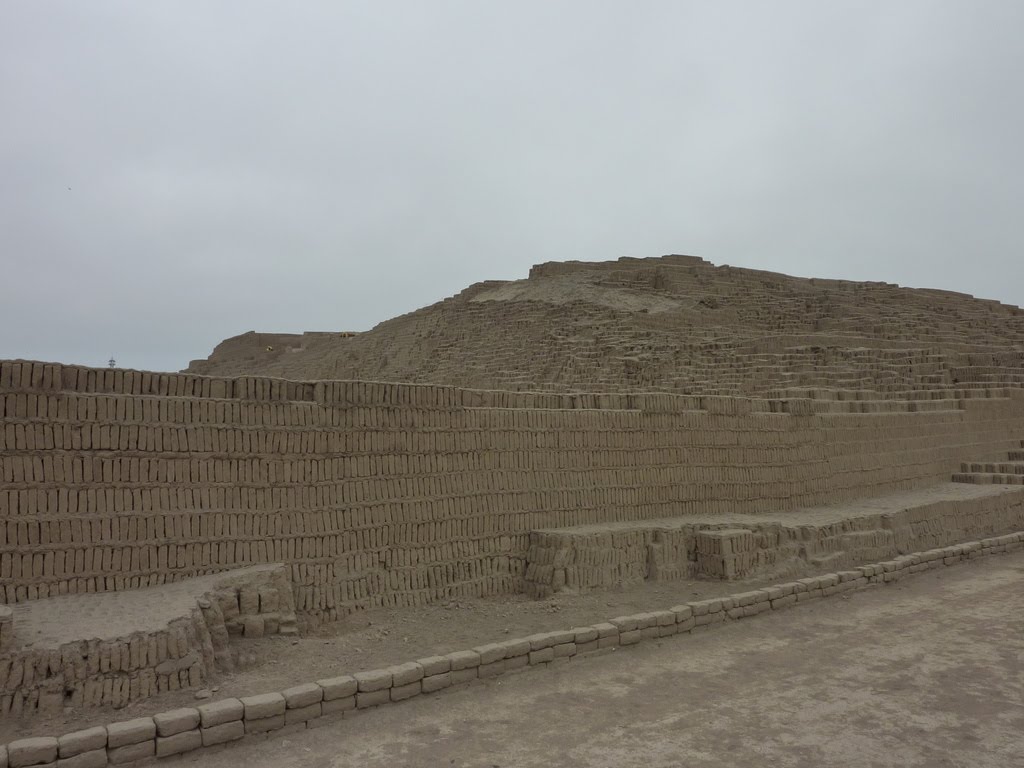
Our last morning in Lima was spent at the Huaca Pucllana, a pre-Inca site founded by the Lima tribe and allegedly used as a temple to worship the gods of the moon and the sea. It is currently being 'excavated' although 'rebuilt' seems a more appropriate description: allegedly only 30% of the site has been reconstructed but it looked so perfect, we found that hard to believe. Apparently the temple site was neglected until the early 90s, at which point it was being used as venue for drug dealing, prostitution and even dirt-bike competitions. Of course more recently the government has started taking the many Peruvian ruins more seriously (because ruins = tourists = money). It was well worth a visit, and has definitely whetted our appetites for the Inca Trail!
Tired after our early flight from Santiago, we decided to hang out in Miraflores for the day. We had lunch in a packed local cafe. Menu del dia = 2 courses and a drink for the princely sum of £1.60. Towards the end of the meal the elderly guy at the next table leaned over and starting talking to us in perfect English: turned out he had been married to an Englishwoman and lived in New York for years, retiring only a couple of years earlier to his native Peru. He was very proud of his neighbourhood, and told us all about his local community centre that organised weekly trips for him and his fellow retirees. It was at this point we started to relax, and thought that perhaps we might enjoy our stay here......
After a little nap, I was keen to see something of the 'local sights' so we caught a cab to the Museo de la Nación, which according to the guidebook was a 'treasure trove' of pre-Incan artefacts. We arrived just half an hour before closing time, but as it turned out this was enough: the seven storey building was almost totally empty! Restoration work is apparently underway, although from the looks of things it'll be a long time before the place is up and running again. There were a couple of temporary exhibitions open, but it was a slightly surreal experience wandering around the concrete edifice trying to find them – no one seemed to want to point out the way. Eventually on the sixth floor we found an exhibition: a photographic retrospective of the horrendous violence which Peru saw during the 1980s as a result of the Shining Path, a Maoist-communist terrorist organisation led by university professor Abimael Guzmán. I think BBC News has been sheltering me for the last 27 years as many of the images we saw were horrific.
Sobered as a result of this experience, the next day we headed into the city proper. We decided to brave the bus, which was a pretty intense experience. Lima appears to be overrun with competing bus companies offering cheap transport around the various districts. As a result, the companies all vie for the custom of passing pedestrians: as well as drivers, each bus has a conductor who hangs out of the door of the bus, shouting the destinations and encouraging anyone and everyone to climb on board. There was a lot of crazy driving, lane changing and horn beeping – felt very much like being back in China or Vietnam. But we made it!
Posted in
Labels:
catacombs,
fear of death,
inca ruins,
lima,
menu del dia,
peru,
south america
|
0 Comments »
Subscribe to:
Posts (Atom)