Wellington. A capital city, or a town?

Friday, September 3, 2010 by Sarah
I was grateful to set foot on the north island after a very rough crossing from the south. I felt sick for approximately 80% of the journey, which I'm sure was entirely due to the waves, and nothing at all to do with my morning of wine-tasting. As it was already early evening, and raining, we decided to head straight to our campsite and not venture to the city until the morning.

Fortunately the next morning dawned bright and sunny, and so we set off for the capital, full of excitement about being back in an urban centre after 2 weeks of country living. As the first stop in the north, this also meant the beginning of uncharted territory for James, whose last trip to New Zealand was confined to the snowboarding meccas of the south.

We began with a tour of Te Papa, New Zealand's premier museum, and home of all things Maori (translated, “te papa” means “our place”). It was absolutely enormous, with loads of different exhibits organised seemingly haphazardly. As a result, we were a little bewildered as to where to begin, especially as we refused to resort to using a map – on principle, I might add. Entrance to the museum was free, but you then had to pay the equivalent of an entrance fee to buy a map of the place, and to go on a guided tour. Very cheeky. Eventually we found our way to the things we wanted to see, and enjoyed wandering around life-size models of marae (Maori meeting houses), parekhas (food storage huts) and wakas (war canoes). From the exhibit about early English settlers, we learned that to pass the time on the 5 week sailing voyage between England and New Zealand, common pastimes included “having affairs, and placing bets on dessert-eating competitions between fellow passengers.” Sounds awesome.

Our 'museum stamina' appears to have gone down, rather than up on this trip, and so after about an hour and a half we'd had enough. Full of good intentions to return again later, we left, and wandered into town. We walked the length of Cuba Street, home of edgy vintage shops and cool cafes, and also a water feature made up of trowels which literally had James riveted for about 10 minutes. I had to pull him away. We also enjoyed a trip in the cable car to the top of the hill, which gave great views over the city, and a walk down through the Botanical Gardens. The first curator of the gardens used to live on site, and he and his wife met for lunch everyday on the same bench, with sandwiches she'd prepare each morning.

Now although it is the capital of NZ, it only has a population of some 500,000 people, and so is one of the smallest capitals we've ever been to. Really it's more like a town. A nice town, but a town nevertheless. By about 5pm (including a 2 hour stop at the hospital to get my stitches removed) we were done, and with a long drive to Napier ahead of us, we decided to start that evening (sorry, Te Papa). As we were leaving, the heavens opened, and we drove for a couple of hours along mountain roads through driving rain. It was too far to Napier in those conditions. Instead we made it as far as Masterton, 'famous' in certain circles for an annual 3-day sheep-shearing competition. Nuff said.

It's ok for me to be drunk at 10.30am, right James?

Wednesday, September 1, 2010 by Sarah
As the home of both Villa Maria and Cloudy Bay vineyards, we were very excited about the prospect of wine tasting in the Marlborough region. Arriving just before lunch time, we were able to get on to a minibus tour for that afternoon. They do also let you do a self-cycle trip around, which James was very keen for, having missed Le Tour, but with one injury already, and not being the most proficient of cyclists, I persuaded him that being driven around was much better - “that way, we get to drink more. And buy more wine!”

We were picked up by the lovely Coleen, who with her husband Dave runs Highlight Wine Tours. Rather than having a set itinerary, they find out what sort of wines and vineyards you are interested in, and shape the tour around that. Seems like a fantastic idea to us.

And so, with stops to pick up another two young couples, we were off. Our first stop was Hunter's vineyard, one of the first to be set up, in 1979. Sadly Ern, the original owner, died shortly afterwards, so ever since it's been his wife Jane who has run the show in his memory, picking up all manner of 'women in wine' awards in the process. We sampled a wide variety of their wines, including their Kaho Roa 2007 (an oak aged Sauvignon Blanc) and The Chase 2008 (a blend of Pinot Noir and Merlot) and whilst all of them were good, none really stood out for us.

Hunter's had definitely whet our whistle and so we were ready for the next stop – Spy Valley wines. Spy Valley is so-called because it is located next to a satellite comms monitoring system (otherwise known as a spy base). Someone has really thought through the branding here (apparently all done in-house) and there are a lot of nice little touches – Morse code runs around the neck of the bottle, and the premium range is called Envoy. We were served our wines by a lady who was a former banker from the City – what a change from that to this! Here we particularly liked both the Sauvignon Blanc 2009 and the Riesling, and ended up buying a bottle of the former.

Our third stop was Gibson Bridge, the smallest of the vineyards in Marlborough, and definitely the funkiest cellar door we've ever seen. Black walls, chandeliers and red moulded plastic chairs – we loved it! Run by a husband and wife team (the slightly eccentric but lovely wife was our server) the vineyard had a really boutique feel – being so small they are able to try new things and see how it goes, including a delicious Pinot Noir this year. Generally they are famous for their Pinot Gris wines, all of which we sampled, and all of which were delicious.

New Zealand cellar doors are incredibly generous in terms of the numbers of wines they let you taste. At this point we'd drunk a minimum 7 wines at each stop, and so were starting to feel nicely merry, just in time for our trip to Cloudy Bay. I was very excited about this, and I can report that the view from the window is in fact of the cloudy bay pictured on the bottle. As you'd expect, the cellar door was a very slick affair, and the tasting room looked like someone's (very premium) weekend cottage living room. We r eally liked the 2007 Te Koko here, another gently oaked sauvignon blanc.

Wine tasting complete for the day, we then headed to a microbrewery called Moa just around the corner. Apparently more and more boutique breweries are springing up in this area, so it was interesting to see one. I don't remember much of the beer, other than the fact I found myself trying to 'beer taste' as you would normally wine taste. Idiot. The cider was good though.

Having not managed to make it to Villa Maria on our wine tour (the vineyard is a little out of the way), I was adamant that we had to make a pilgrimage to it the following morning, before we caught our ferry. James pointed out that we would have to start drinking at 10am as a result, but I was not to be put off. And so at about 9.45 the next morning we pulled up at Villa Maria's cellar door. Fortunately they were already open (just) and so we didn't have the ignominy of having to knock on the door to be let in, although we were the first customers of the day.

Villa Maria offer tastings of wines that they don't sell internationally, and so we were excited to try them all, especially Viognier 2008. We were served by a lovely and knowledgeable girl who told us all about the history of the company – founded by a 21 year old called George Fistonich in 1961, who has gone on to build the brand to become the most awarded wine in the country. As James was driving, he had to pick and choose what he actually tried, but again, I boldly sampled the whole range (purely for research purposes you understand). Very much enjoyed seeing where our favourite sauvignon blanc is produced, and we left clutcing a bottle of Viognier, two very happy campers.

Still with a little time to kill before our ferry, I suggested we pop in next door to Wither Hills, which we've tried a couple of times at home. Our server was a large Kiwi man called Peter who told us he was a Chardy boy, through and through.” Classic. Although even I had to agree, as a confirmed non-Chardy girl, that their offering was pretty good.

And that is how I came to find myself, drunk for the second time in 12 hours, shortly after 10.30 in the morning.

A day on the road

Tuesday, August 31, 2010 by Sarah
Having already driven some 2000 km over the past week and a bit, James faced yet more driving as we embarked upon the longest journey so far: from the West Coast cross-country to the East Coast. In order to break the journey a little, we drove the first stretch immediately after our Glacier Day, heading up to Greymouth that night. Greymouth is a little coastal town with a pebble beach. We had a quick walk around, but didn't stick around long, especially when we found out the McDonalds here in New Zealand don't have wifi. Shocking.

From there we continued across to Hanmer Springs, about 3 hours away. Hanmer Springs is famous for, funnily enough, its hot springs, and after a long time in the car, plus the previous day's exertions, we decided to indulge. Hanmer Springs is a series of 9 pools of varying temperature, from 33 degrees all the way up to 41 degrees – basically the hotter it gets, the more it smells of sulphur. We enjoyed a good long soak, although I got a few odd looks: one of the life guards gave me a surgical glove to cover my injured thumb and keep it dry. I looked like I was some kind of weird Michael Jackson fanatic, although from my point of view, even this was better than holding my thumb out of the water in the 'thumbs up' position, as I did for the first 15 mins! We also treated ourselves to a private sauna which was lovely – saunas have been few and far between since we left home.

Suitably refreshed, we continued on to Kaikoura. The drive there along Lewis Pass was stunning: winding roads carved into the mountainside, shrouded in mist. And Kaikoura itself was breathtaking: craggy mountains fall spectacularly, and almost directly, into the ocean. Kaikoura means “crayfish food” in Maori and was originally a local fishing capital. Today, whilst its restaurants are still renowned for producing quality seafood, it's known as more of a natural paradise. We had hoped to swim with dolphins but the sea was a little too choppy, so our trip was cancelled. Instead we visited the seal colonies, both at Dean Point in Kaikoura itself, and then just up the coast at Ohau. Dean Point is home to a small colony, where we saw 3 little pups playfighting and racing each other in the water. We also saw the biggest seal daddy ever, with enormous whiskers, sleeping on the boardwalk. We must have disturbed his sleep as he growled at us warily, but we made sure we kept our distance – apparently a tourist was recently bitten by a seal after getting between a female and her pup!

Ohau is home to a much bigger colony, with well over two hundred seals sunning themselves on the rocks as we drove past. Before we left Kaikora a local we'd met told us that we should definitely check out a small national park that was just up the road and inland from the colony. What an amazing tip! Just inside the forest we found a fast flowing stream that ran through several rock pools down to the sea, fed by a waterfall. The stream acts as a kind of crêche for the seal colony, so we found about forty or so little seal pups playing there. They were chasing each other's tails and playing fetch with pieces of wood and seaweed, and hopping up and downstream over the rocks to get to the different pools. Incredibly cute. We didn't make it quite to the top and the waterfall, as one pup had decided to go for a wander along the path and lay in our way. We both spotted each other at the same time and I'm not sure who was more shocked. I let out a squeal, and he immediately sat up and started growling. We made a quick exit, just in case! But at least I know that seal noises are one of the few impressions I can do that actually sound convincing.

Glacier Day

Monday, August 30, 2010 by Sarah
Probably the most action-packed day of the trip so far was the Monday morning we woke early to drive the 3 hours north from Wanaka to Fox Glacier. Well, I say 'we' but what I mean is James. I slept most of the way. Apparently the views were pretty good.
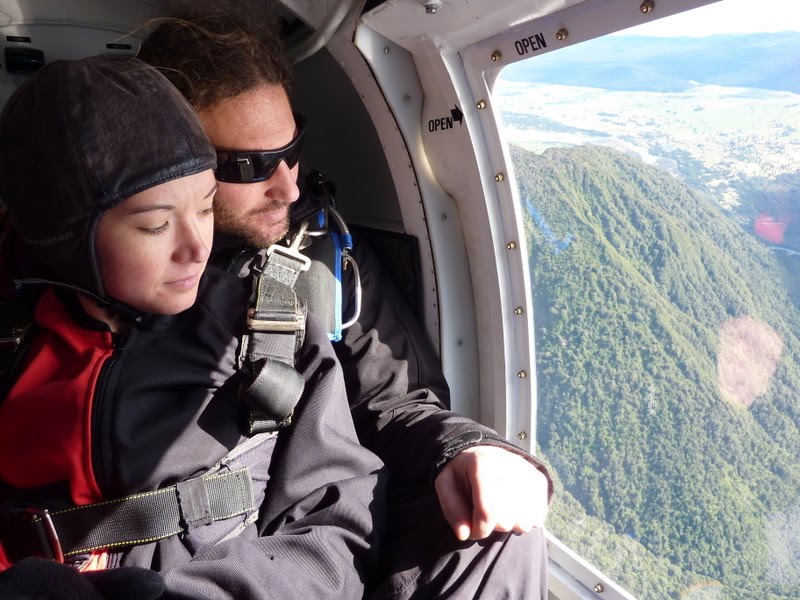
The reason for our early start was because we'd had confirmation that for the first time in a week, the weather was going to be perfect for doing a skydive – crisp and clear. Now as most of you will know, I am not the most dare-devil of souls, but skydiving is something that has always been on my bucket list. That said, as we arrived at the airfield my nerves started to get the better of me, and I turned very white as the reality of what we were about to do started to hit me. Just as well really that we were almost immediately strapped into our rather fetching patchwork clown suits and goofy hats. Before I really had time to register what was happening, we were cl ambering into the plane and taking off.

It took an age to climb to 12,000 feet. But the view was just spectacular – we flew over Fox Glacier, with the Fox River increasingly far below us. It also gave James time to take lots of pictures of me looking sick with fear. And then all of a sudden, the hatch was open, and James was being launched feet first out of the plane. I followed quickly after – since this was a tandem skydive, and you're strapped to your instructor, you actually have very little involvement in the jumping itself. Left to my own devices at that point I'd probably have been cowering in the corner of the plane, refusing to move.

One second I was dangling precariously out of the open door, the next we'd jumped and were falling through the air, experiencing some 45 seconds of free-fall. After my initial internal monologue: “What the hell are you doing?! You've just JUMPED voluntarily out of a plane, you idiot!” I a) remembered to breathe and b) started to enjoy myself. Especially once my instructor pulled the parachute cord and it opened. Relief!

For me, the best bit was the parachuting. The view below was incredible: a 360 degree panorama. We were surrounded by the enormous Fox Glacier, the local rainforest, the mountains and, behind us, the Tasman sea. And it was nice and slow after the rush of free-fall! James was busy being told which photos of himself to take by his instructor: “Now one of your feet.....now one looking back up at yourself.” All too quickly it was time to come in to land (me a little before James because spinning around to admire the view had made me slightly queasy!). I concentrated very hard on keeping my knees tucked into my chest as per my briefing instructions to avoid any nasty broken bones or twisted ankles, which apparently is one of the most common skydiving injuri
es. And then I was on the ground, hyperventilating and laughing simultaneously as the adrenalin flooded out of my system.

45 minutes after arriving, we were back on the road, driving the short distance to Franz Josef ready for the afternoon's activity – a walk on Franz Josef Glacier. We just had time to grab a quick lunch in the interim, during which we did little other than grin at each other occasionally and say “we just did a skydive!!”

Our 'tour' of the glacier was with Franz Josef Glacier Guides, who make you feel like you're going on a proper adventure to the Antarctic or something – there is a lot of kitting up involved. We were given extra jackets, trousers, socks, heavy-duty walking boots and crampons, these last carried in a stylish red bumbag. Once everyone in the group was ready, it was a short bus ride to the glacier itself.

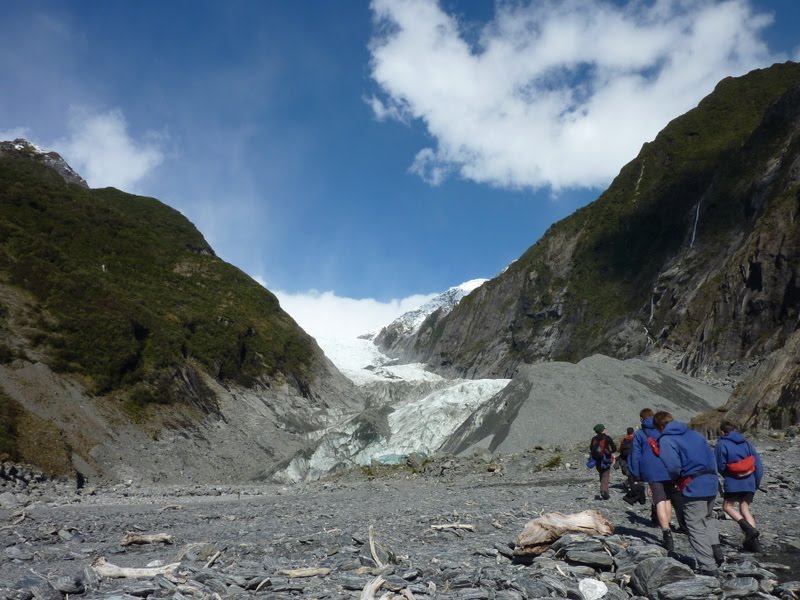
Franz Josef was 'discovered' in 1903, at which point it was a lot bigger than it is now. Glaciers apparently ebb and flow over time as the ice melts and new ice forms, although overall it is a lot smaller than it used to be. You used to be able to walk right onto it, but now we faced a 2.5km walk just to reach the glacier, including a steep climb up a large pile of rocks. However, this meant we had an awesome view on the approach to the Glacier, some 11km high, of which only 7km is visible from the base. It's pretty high.

Finally we reached the top of the rockpile and it was time to strap on the crampons ready for our glacier walk proper. I have to say, crampons look to me like some sort of antiquated skiing equipment or animal trap. You would've thought someone somewhere would've come up with something a little more modern by now. That said, they do work very well on the ice, even though I felt a little like John Wayne walking with my legs wide apart and lifting up my feet in an exaggerated fashion (to avoid falling over).

Walking on the glacier was cool – we wandered through ice passages and up steps carved into the ice on a daily basis by the guides. At the top (well, the top as far as we were concerned, our summit for the day) we had a fantastic view of the valley below, and got to sample a bit of the glacial water, which was deliciously icy cold. But mostly we took the opportunity to take some goofy shots on the ice, still grinning like idiots as a result of the day's adventures.

Wild Wild West (of New Zealand)

Sunday, August 29, 2010 by Sarah
We spent a very pleasant day and night in Arrowtown, a small village which looks like something out of the Wild West. Little wonder when you know it was originally settled as a gold-mining town in the 1860s, following the discovery of gold in the Arrow River (after they'd been initially drawn to the Shotover). As James mentioned, a lot of the prospectors came from Australia, but there was also a sizable contingent of Chinese men in search of their fortune. We visited the Chinese settlement, a little row of houses just outside of town, which has been partly reconstructed by the local tourist association. It's a pretty depressing place – the Chinese were hugely ostracised by the European community and 1 in 7 died as a result of their poor living conditions. That said, their resilience in the face of such hostile circumstances is pretty staggering: the last Chinese man living in the settlement survived until 1925.

I'd heard a lot about Arrowtown from James, largely in relation to the amazing time he had there with Eddie at the cinema. To be fair, it was pretty darn good: a boutique arthouse cinema with only two screens, offering comfortable sofa chairs, bottles of wine and cheese platters during the intermission. All very civilised. We watched Harry Brown. Great film, but much darker and more harrowing than I was expecting. As a result (and probably also as a consequence of the half bottle of red wine I'd drunk during the film), I was feeling so maudlin on the journey home that I had to watch the first half of 3 Men and a Little Lady to cheer myself up before going to bed.

From Arrowtown we journeyed on to Wanaka, the jumping off point for the Cardrona and Treble Cone ski resorts. With my thumb and the weather both working against us, there was no more snowboarding in store, which left us at something of a loose end. Just as well really, as our wine consumption at the cinema had left us both with slightly fuzzy heads and an inclination for a 'sofa day.' This we indulged with hot chocolates at a local cafe, and a gentle walk around Lake Wanaka, along with four episodes of Lost whilst sipping tea in the van. I really wanted to go to Puzzlingworld, a local attraction boasting 3D puzzles and a 'visual maze.' But James said no. So I have no idea whether it was any good. I imagine it was probably pretty awesome.

Milford Fjord

Friday, August 27, 2010 by James
Milford Sound is probably the number one tourist attraction in the South Island. It's found in the Fjordlands – an enormous national park full of mountains, lakes (Sarah: 'New Zealand. It's all just mountains and lakes really, isn't it?') and fjords, which we learned are flooded valleys that have been carved out by glaciers. To get there from Queenstown is a 5 hour drive, and as we wanted to be there first thing in the morning for better views and less crowds, we decided to stop halfway in quiet lakeside Te Anau, which sits at the border between the rolling arable Southlands and the more aggressive Fjordlands.

After a picnic lunch parked in our van by lake Te Anau we went for a walk along the shore, staring out over the water at the forbidding mountains we were going to be driving through the next day. I tried to teach Sarah how to skim stones but she somehow managed to throw a rock at herself (from her left hand, into her upper right arm. Unbelievable) so to avoid any further Queenstown-esque injuries I suggested we maybe give the skimming a rest and head back.

The next morning we woke up early and were on the road to Milford Sound by 6.30. I was a little edgy about the drive as the road through the Fjordlands can be treacherous, and had been shut the previous week due to snow. We had snowchains in the boot, but I wasn't too keen to try them out. We were lucky: One valley still had a good dusting of snow on the road, but the rest were fine. Despite piloting what is essentially a large fibreglass box on wheels, the drive was fantastic. We entered the national park as the sun was rising, so we got to watch the mist that filled the valleys burn away to reveal snow-capped mountains and dense forest. We reached the Sound 5 minutes before our cruise left and were soon chugging out from the harbour with pockets full of Cookie Monster cookies for the trip.
Milford Sound was discovered by a Welshman called John Grono, who landed there to shelter from a storm. He named the place Milford as he thought it looked a lot like his home town of Milford Haven. I've been to Milford Haven. I reckon he must have been at sea for a bit too long. John was also mistaken in calling Milford a Sound. Milford is actually a fjord – a flooded valley carved by glaciers, as opposed to a Sound which is carved by rivers. Milford Fjord is pretty hard to say though, so they left the name alone.

Whatever it's called, it was actually carved out by no less than 6 different glaciers of different sizes, which resulted in several 'hanging valleys' - smaller shallower valleys that join onto the larger deeper ones, emptying their rivers down into the Sound in dramatic waterfalls. So that we could experience these waterfall in all their glory, our boat captain steered us right in under one of them. We managed to stand out on the foredeck for about 10 seconds before being totally drenched. Woke us up a bit after our early start anyway.

The whole cruise was incredible, but our favourite part was when a pod of bottle-nosed dolphins playing in the bay came over to investigate our boat, and then hung around us for twenty minutes, surfing the water that our boat's prow pushed out in front of it. They were clearly having a great time – jumping out of the water, spinning onto their backs and swooping around each other. The whole boat was crowded onto the bow, leaning over the rails to watch them.

“Back yourself”

by James
...The advice New Zealand Prime Minister John Key gave at an award ceremony for high achieving high school kids. Awesome.

He then went on to compare their evidently winning attitude to that of the All-Blacks, and their likely victory in the 2011 World Cup: '...[their winning attitude] is why they should win the World Cup next year. Of course if they don't, I'm going to tazer Richie McCaw'.

Name me another country where the PM can even jokingly threaten a national sports team captain with violence. Or one where tazering someone would be top of mind...

Just two sweet-as boarders rockin' the Remarks

Thursday, August 26, 2010 by James
Twisty roads hacked into canyon walls lead us into Queenstown. Lord of the Rings type scenery. Lots of tors and vales and mountains.

This little huddle of smart buildings on the shores of Lake Wakatipu was once a tiny farming town until two yokels discovered gold in the Shotover River in 1856. Experienced and novice prospectors from Australia and China descended en masse, mining the place dry within 40 years. After that, Queenstown was left for dead until its two very ski-able mountain ranges and gorgeous lake facilitated a reincarnation in the 1950s as a tourist mecca. This reputation as a Destination was then turbo-charged in the 90s as aggressive geography and the lax Kiwi safety regulations enabled it to become the self-proclaimed Extreme Sports Capital of the World.

We arrived in Queenstown late in the afternoon after a long drive from Dunedin. Like Methven, being in Queenstown brings back lots of memories from my snowboarding holiday with Axit, Ed and Will. I'm sure I bored Sarah stupid with an unprompted tour of the town centre: '...and this is Winnie's where I wore my potted plant fancy dress outfit and some guy tried to piss on me', 'That's the Southern Laughter where we drank sake in the hot tub and Axit threw up in a bin', 'Over there is the Subway where Will used to order double-meat foot-longs after a hard day at the Remarks'. 'This is the spot where I nearly drove Ed and myself into a bus'. It was good to be back.

Before the shops shut that evening we were able to hire snowboarding gear and lift tickets for the following day at The Remarkables ski resort. (Opinion is divided as to whether this name is due to the fact that the mountains simply look 'remarkable' or whether they are more scientifically named as remarkable as they are one of only two mountain ranges in the world that run directly north-south. Having met a number of Kiwis, my money's on the former reason). As we only had one day in our itinerary to get up the mountain, I persuaded Sarah to try snowboarding for the day. I dredged up all the lessons I remembered from when I learned and barraged Sarah with them all at once: 'Pretend you're sitting on a toilet', 'Do less', 'Imagine you're carrying a tea tray', 'Look as cool as possible'. Despite all this good advice Sarah did incredibly well, and by the end of the day was casually swooping back and forth down the mountain.

To celebrate her achievement, I suggested that we sit on our boards and toboggan down the last 20 metres to car park where the bus was waiting to pick us up and drive us back to Queenstown. I reached the bottom before Sarah, and as I turned to watch her coast the last few metres and get ready to dish out the hi-fives, she held up a right hand, dripping with blood.

In the doctor's in Queenstown we learned that she had when she caught her thumb under the board edge she had sliced completely through her skin and right down to the joint capsule, just missing the tendons. We also learned that I'll be of absolutely no use during child-birth as I nearly passed out – twice – whilst she had a couple of stitches put in.

The upside of the whole experience for Sarah, aside from discovering a natural snowboarding (but not tobogganing) ability, is that her stitches prevent her from doing any cooking or washing up for the remainder of the trip.

Dunedin: a very Scottish place

Tuesday, August 24, 2010 by Sarah
Dunedin is the largest town in the Otago region. Settled as a sealing and whaling town in 1848, it has a massive Scottish heritage: 'Dunedin' is the old Gaelic word for 'Edinburgh' and there are apparently more piping bands here than in the whole of Scotland.

Today Dunedin is a thriving student town, which suited our backpacker budget – we had cheap bento for lunch and very reasonably priced haircuts. We spent a couple of hours at the Otago Museum, famous for its Victorian-era natural history section, which has recently been restored to its former glory, complete with cabinets of taxidermied animals and insects pinned onto boards. It reminded us a lot of a miniature version of London's Natural History Museum. The building lies on the edge of the university complex, meaning we could pretend to be students for an hour or two, although we probably didn't look trendy enough, especially in our matching jackets!

We had a quick wander around the Edwardian railway station (it looks like Bristol's) and admired the purple and white branding of the Cadbury factory, but the main objective of our visit was the Speight's Brewery. Speight's is the South Island's premier beer, known as the 'Pride of the South,' marketed with some tongue-in-cheek 'real man' adverts. The factory was fantastic – all original Victorian mouldings and brewing apparatus, still in use today, over 130 years after Speight's first started brewing (in 1878). Bizarrely it reminded me of the old science labs at Denmark Road School – I kept expecting to see Mrs Gibson popping out from somewhere, brandishing a test tube. But the best bit was the tastings at the end of the tour, where we were able to pour our own glasses of each of the beers on tap. It's clear I've never been a barmaid, but I got there in the end. Our favourite was the 'Empire' winter special brew: judging by our circuitous route home, we probably enjoyed a little too much of it......

Penguins!

Monday, August 23, 2010 by Sarah
New Zealand is famous for its wildlife, including dolphins, sea lions, albatross, and PENGUINS. Somewhat by chance, we ended up having a Penguin Day pretty early on in our NZ adventure.

We started out at the Antarctic Centre, just by Christchurch airport. Christchurch is the last stopover point for 70% of all expeditions to the Antarctic and South Pole, as it's the most southerly urban centre before you reach the great white continent. Not knowing much at all about Antarctic exploration, we decided to pay a visit. It seems like the Scott Base, where scientists live during months-long expeditions, is a bit like a long-term adult freshers week: copious booze consumption, often in fancy dress, resulting in odd pairings between hot girls and geeky men. At least, that's the impression we got from the photos they send from the Base on a daily basis. The Antarctic Centre was also big on interactive displays. Trapped in what felt like a snow globe, we got to experience what it felt like to be caught in the middle of a snow storm, with a windchill drop from -8 to -18 degrees. As if our first 48 hours in New Zealand hadn't been cold enough already.
But the highlight for me was the penguins – we saw about 40 Little Blue Penguins (actually the name of the species) being fed. The blue penguin is the smallest of the penguins living in the South Island and Antarctica – weighing just 1kg, they are tiny and incredibly cute. Sadly all of the penguins kept here cannot live freely in the wild – a couple were blind and a lot have problems with their feet, the treatment for which was for them to wear little pink and green slippers. That said, they all seemed to lead very happy lives here (one of them ate 34 fish in a day a couple of days before our arrival).

This visit had given us a little insight into penguins, but we wanted to see more. So after a quick stop at Methven, we headed down the coast to Oamaru on the Otago Peninsula, New Zealand's penguin HQ. We began with a trip down to Bushy Beach, home to a small yellow-eyed penguin colony. Bigger than the blue penguins, there are only 1000 or so of them left in the wild, and none in captivity, so we were very lucky to spot a few. And then we headed back up to the Harbour, where there is a much larger Little Blue Penguin colony.


Arriving just before sunset, we saw 70 or so of these little creatures come onshore and settle on land for the night. I have never seen anything quite like it – groups of penguins time their swim inland so they are washed ashore by the waves, and then have to waddle onto the rocks before the next wave can pull them back out again. They spend a good 15 minutes clambering up the rocks, before pausing, checking the coast is clear, and finally making a dash for their homes at the base of the cliffs. Watching them waddle home to their nests, squawking at each other as though to say “see you tomorrow, Bob” “Night then Jim” was just adorable.

We were warned to keep an eye out for wandering penguins on the short drive back to our campsite. We had thought the guides were joking, until we spotted a couple of inquisitive penguins waddling AWAY from the colony, towards the road, in search of adventure. We dodged a couple by the roadside and had to wait for another to cross the road before we could drive home! Fingers crossed they all made it safely home again......